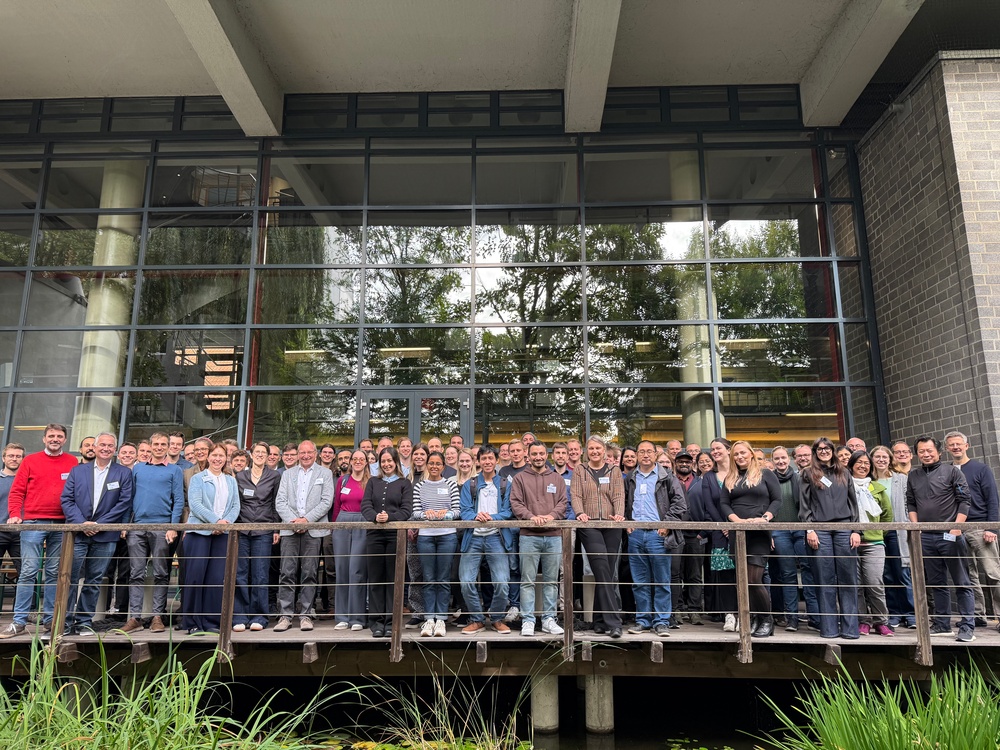
How can chemical reactors be controlled more precisely and complex processes better understood? These were the questions addressed at the 2026 Annual Conference of the Collaborative Research Center (CRC) 1615 “SMART Reactors,” held October 7–9, 2026, in Hamburg. About 90 participants from the participating institutions and other guests gathered at the TuTech Innovation GmbH building on Harburger Schlossstraße to present current research and discuss the further development of the joint research program.
The focus was on the development of intelligent reactor systems that combine functional materials, innovative sensor technology, experimental methods, and data-driven models. The goal is to better understand chemical and biochemical processes and influence them in a more targeted manner.
The subprojects presented their research in both oral presentations and poster sessions. Topics ranged from transport and mixing processes in microreactors to the investigation of complex multiphase flows and the development of functional electrode structures for bioreactors. Other presentations addressed stimulus-responsive hydrogels and lyogels, adaptive surfaces, and the integration of functional materials into adaptive reactor geometries.
New methods for process monitoring were also a key focus. Among other things, the conference featured presentations on the use of electrical impedance to determine process parameters, hydrogen sensing, spectroscopic methods, and innovative sensor particles for investigating flow processes. In addition, the researchers discussed data-driven simulations, multiscale modeling, and machine learning-based methods for controlling intelligent reactors. The presentations illustrated how experimental findings, measurement data, and mathematical models can interact to improve our understanding of processes and further develop their control.
In addition to scientific exchange, a key objective of the conference was to further develop the research program for the second funding period. In intensive discussions, participants worked on common research questions and the next steps in their research. The Scientific Advisory Board contributed additional external perspectives. Dr.-Ing. Joachim Ritter from Bayer AG attended in person; other members of the board joined online.
The conference provided a platform to bring together scientific advances, discuss new approaches, and strengthen interdisciplinary collaboration. Feedback from participants particularly highlighted the progress made, the successful cooperation, and the strong team spirit.
Through their work, researchers at CRC 1615 “SMART Reactors” aim to make reactor systems smarter and more adaptable by combining materials, sensor technology, modeling, and process control.
Learn more: Website of the Collaborative Research Center (CRC) 1615 “SMART Reactors”
Note: This text was generated with the assistance of AI and has been editorially reviewed.