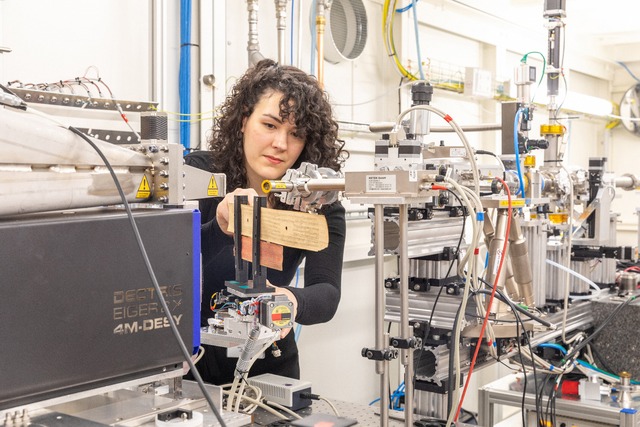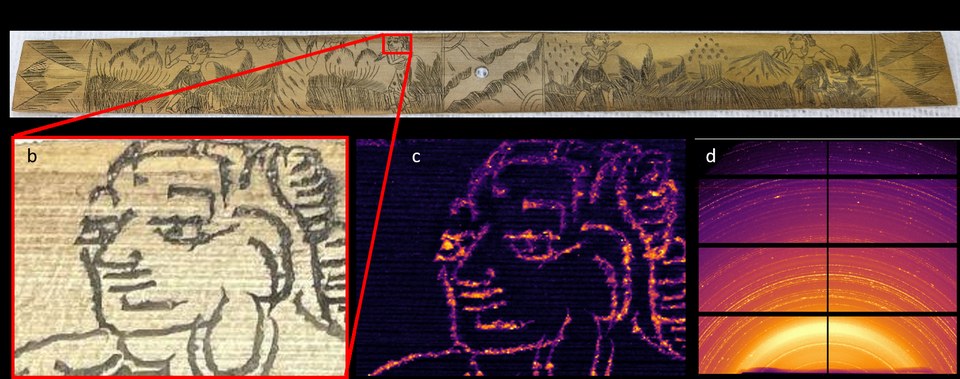
For centuries, people across South and Southeast Asia recorded religious teachings, literary works, legal regulations and scientific knowledge on palm leaves. Before they could be inscribed or written on, the leaves had to undergo extensive preparation, with processing techniques varying across regions and potentially leaving distinct material signatures. Today, reconstructing how they were processed and where they originated can be challenging. An international research team has investigated what the structure and chemical composition of the material can reveal about these objects. The researchers combined X-ray analyses at PETRA III at DESY and at the ESRF with machine learning. The findings have been published in npj Heritage Science.
Comparing 160 material entries
The study examined 160 material entries: 85 manuscripts, and 75 modern reference materials. The materials came from different collections and regions across South and Southeast Asia. The team investigated whether their material properties could help distinguish the palm genera used, identify different stages of leaf processing and reveal possible links to geographical provenance.
The measurements were carried out at experimental station P62 at DESY’s PETRA III X-ray source, as well as at the European Synchrotron Radiation Facility (ESRF) in Grenoble, France.
Laura Gallardo, first author of the study and scientist at Hamburg University of Technology (TU Hamburg), emphasises the importance of the non-destructive approach: “For rare and fragile cultural artefacts, the ability to obtain rich structural and chemical information without taking a sample is essential. By combining several synchrotron techniques, we can read different layers of a manuscript's material history in a single experiment and compare large numbers of objects in a systematic way.”
Processing leaves a measurable material signature
The results show that the two palm genera examined can be distinguished comparatively reliably on the basis of their material characteristics. Processing plays an important role: after treatment, the differences between the palm genera became more pronounced. The measurable properties therefore reflect not only botanical origin but also different responses of both genera to manufacturing practices.
Patrick Huber, Director of the Institute of Materials and X-ray Physics at TU Hamburg and head of the “High-Resolution X-Ray Analytics of Materials” research group at DESY, explains this limitation: “The material data alone cannot yet establish geographical provenance with certainty. The properties of the leaves are shaped by several interacting factors, and the available sample groups are not equally large. The findings therefore need to be interpreted alongside historical and codicological evidence.”
Material analysis complements manuscript research
Material analysis offers manuscript scholars an additional way to investigate historical objects. Giovanni Ciotti, a manuscript scholar at the University of Bologna and the Centre for the Study of Manuscript Cultures, explains: “For manuscript studies, the most exciting point is that material analysis can reveal relationships that are not visible from script, form or catalogue information alone. These physical signatures become culturally meaningful when they are interpreted together with codicological and historical evidence - for example when we ask whether different objects may share manufacturing traditions or routes of knowledge transmission.”
The study shows how combining different X-ray techniques can reveal complementary material aspects of palm-leaf manuscripts. Together, these measurements make it possible to detect material differences related to plant genus and processing and to explore how such features may reflect different manufacturing traditions, diverse across the geographical origins considered. When analytical results are considered alongside historical and codicological evidence, they provide a new way to investigate how manuscripts were produced, treated and used, and how some of these extinct traditions may have changed and diversified over time and across South and Southeast Asia.
The work was carried out as part of the Hamburg-based Cluster of Excellence “Understanding Written Artefacts” (UWA) at Universität Hamburg.
Original Publication:
Laura Gallardo, Mark Busch, Anastasia Poliakova, Giovanni Ciotti und Patrick Huber: Multimodal synchrotron X-ray analysis of palm-leaf manuscripts: structural and compositional signatures of botanical genus, manufacture, and provenance. npj Heritage Science, 2026.